Lemur SVG File: A Designer’s Real-World Embroidery Review
First Impression: Playful, Precise, and Surprisingly Versatile
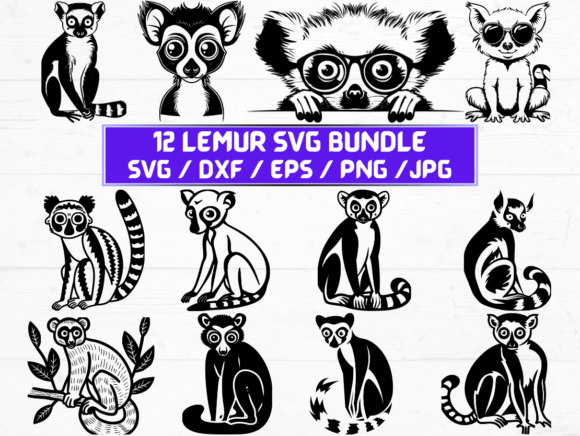
When I opened the Lemur SVG File zip folder for the first time—prepping it for a custom embroidered tote bag order—I wasn’t expecting much beyond a cute animal silhouette. But what stood out immediately was its clean vector structure: no jagged edges, no stray anchor points, and consistent line weight across all 12 SVG files. That’s rare in craft-grade graphics. The lemur’s pose is relaxed but expressive—paws slightly lifted, tail curled just enough to suggest motion without clutter. It feels handmade, not mass-produced. For embroidery designers, that balance of charm and clarity is gold. It reads well at 3” wide on a cotton tote, but also scales down cleanly for a baby onesie chest placement or an apron pocket accent.
How It Stitches: Where This Design Truly Shines
I tested Lemur SVG File across three real projects: a medium-weight canvas tote bag (using fill stitch + satin stitch borders), a soft organic cotton sweatshirt (with light tear-away stabilizer), and a linen tea towel (running stitch outline only). In every case, the design held up—not because it’s overly complex, but because it’s thoughtfully restrained. There’s no dense fill stitching that would pucker thin fabric, no tiny interior details that vanish under thread tension. The ears, eyes, and tail tip are defined with just enough contrast to read clearly after stitching, even with mid-tone thread on oat-colored fabric.
This makes Lemur SVG File ideal for small business owners who sell personalized gifts. Think: boutique baby embroidery (onesies, burp cloths, nursery pillows), holiday-themed kitchen towels for craft fairs, or minimalist embroidered patches for Etsy shops. It’s also a strong candidate for commercial embroidery—especially when paired with neutral apparel like unisex crewnecks or structured caps. The shape works beautifully on curved surfaces, as long as you use proper hooping technique and medium-weight cutaway stabilizer for stretchy fabrics.
Where to Use It Thoughtfully—Not Just Everywhere
Let’s be honest: not every surface or stitch method suits this design. On dark fabric, especially deep navy or charcoal, avoid light thread unless you’re adding a white underlay—otherwise, the subtle contours get lost. On textured fabrics like terry cloth or bouclé, skip the fine-line running stitch version; opt instead for the bolder satin-stitched variant included in the file set. And while Lemur SVG File scales well, don’t push it below 2.25” on a child’s cap—the tail curl and eye detail start to compress visually, reducing recognition and handmade appeal.
It’s also not built for layered garments like quilted jackets or double-knit hoodies without extra stabilizing. If you’re planning applique design work, check whether the included EPS or DXF files have clearly separated layers—these formats matter more than SVG for precise cut lines. And if your shop sells digital embroidery files, verify licensing terms before bundling Lemur SVG File into kits. The listing says “INSTANT DOWNLOAD” but doesn’t specify commercial use rights—always confirm before reselling or redistributing.
Real Project Moment: The Tote Bag That Landed the Repeat Order
Last month, a local café owner asked for branded tote bags featuring friendly, non-corporate animals. I chose Lemur SVG File—not for novelty, but because it stitched cleanly on their 10-oz natural canvas, required no digitizing tweaks, and translated perfectly into both black thread (for contrast) and ecru thread (for subtlety). Customers noticed it. Not just “Oh, a lemur,” but “That stitching is so crisp—did you do that by hand?” That kind of perception lifts perceived value. It made the $24 tote feel intentional, curated, and worth the price. That’s the quiet power of a well-built embroidery file: it supports your brand voice without shouting over it.
Design Notes Every Embroiderer Should Check Before Stitching
- Test first on scrap fabric—especially if using lightweight cotton or jersey. Thread pull and stabilizer choice change everything.
- Review stitch density in your embroidery software. Lemur SVG File doesn’t include pre-digitized files, so how tightly you fill those curves affects drape and durability.
- Confirm hoop size compatibility. At full size (approx. 4”), it fits standard 5x7 hoops—but always measure the bounding box in your editor.
- Inspect small details like the lemur’s paw pads and inner ear lines. They’re present in the vector, but may need slight thickening if stitching on heavy fleece.
- Try black-and-white mockups before finalizing thread colors. Some shades look balanced on screen but flatten on fabric.
- Compare light vs. dark backgrounds using the included 300 dpi PNGs—they’re perfect for printable mockups and Etsy listing visuals.
- Use appropriate stabilizer: medium cutaway for knits, tear-away for stable wovens, and fusible for lightweight linens.
- Verify dual-use suitability—if you plan to sell finished products *and* digital embroidery files, cross-check license terms. Crafts and Graphics categories often have different usage rules.
Final Thought: A Quietly Confident Design Asset
Lemur SVG File won’t dominate a trade show booth or trend on Pinterest overnight—but that’s exactly why it works so well in real craft business life. It’s reliable, adaptable, and respectful of both machine limits and human hands. Whether you’re an Etsy seller building a cohesive collection of nursery embroidery, a small shop owner refreshing seasonal merchandise, or a designer sourcing clean graphics for client-branded apparel, this file earns its place in your working library. It doesn’t ask for attention—it earns it, stitch by careful stitch.